
Gallup Previous Residents by Era
Previous residents are best traced with sources that state their date and purpose. A modern McKinley tax account can supply a parcel number, legal description, and situs address. It cannot prove occupancy or substitute for title research. For an earlier transfer, the McKinley County Clerk holds the permanent recorded instruments. For an earlier household, a dated directory or census image may offer a lead. Each gap matters: the Clerk has not published a government online grantor-grantee index or its web coverage years, and no complete Gallup reverse-directory run has been confirmed.
| Source | Known time scope | Custodian or repository | Useful address evidence |
|---|---|---|---|
| EagleWeb tax account | Prior assessment values; no historical cutoff posted | McKinley County Treasurer | Parcel, legal description, situs string, account context |
| Recorded instruments | Online range not verified | McKinley County Clerk | Deeds, plats, surveys, liens, and legal descriptions |
| City and business directories | National collection ca. 1749 to ca. 1990; Gallup run unverified | FamilySearch, library, and archives | Dated listing, spelling, and address lead |
| Sanborn map | February 1916 | Library of Congress | Block, building, and street-label context |
| Federal census | 1950 is the newest released census | National Archives research route | Dated household context, not a current address |
Begin with the record nearest the date in question. A recent property question calls for EagleWeb and the Clerk. A family-history question may begin at the library or archives, then return to the Clerk when a legal description or transfer date needs confirmation.
Note: A dated record can support a historical lead, but it does not establish a living person’s current location.
Gallup Parcel Clues Before Deeds
The free McKinley County EagleWeb search is the practical online starting point for previous-resident work at one address. Enter the situs components carefully. The form separates house number, direction, street name, designation, suffix, and unit number. A missing directional or an incorrect street type can make an old address seem absent. When a plausible account appears, retain the account ID, parcel number, legal description, situs text, and the page’s as-of date in a work log.
The result fields help link a modern address to a parcel. They do not confirm current title, an owner’s mailing address, or who slept at the location. The Assessor reports that roughly 80 percent of McKinley County land is reservation or other federally tax-exempt land. That local fact is a strong reason not to treat a missing taxable account as proof that a Gallup-area place or address did not exist.
- Parcel
- A county identifier for a tract or taxable account. It helps join map, assessment, and Clerk research.
- Situs address
- The physical location shown by the record, which may differ from a mailing address.
- Legal description
- The lot, block, subdivision, or survey wording that identifies land more reliably than a changing street label.
For map context, the McKinley County GIS Center coordinates E-911 and mapping work, while the city publishes address points, roads, limits, and zoning through its GIS data page. Neither verified public city interface offers an owner-query map. The defensible chain is address layer, EagleWeb parcel clue, then Clerk record.
Gallup Deed Chain Research
A chain of title follows recorded land transfers, not a list of past occupants. The McKinley County Clerk records deeds, plats, maps, surveys, legal descriptions, liens, and judgments as permanent public records. The office has not published an official online recorded-document search or a coverage start year. That makes the counter, phone, email, or a focused written request central to a Gallup deed search, especially when the address has changed form over time.
- Search the exact address in EagleWeb and write down the parcel and legal-description clues.
- Contact the Clerk with the current owner or entity spelling, approximate transfer year, parcel, and any known book, page, or instrument number.
- Ask for the grantor and grantee index entries or the instrument that conveyed the identified parcel. Confirm the document type and recording date.
- Use the earlier seller or grantee name, plus the same legal description, to request the preceding transfer. Keep each document date beside the source.
- Stop where the record trail changes jurisdiction, becomes uncertain, or reaches a protected matter. Preserve an unknown period instead of filling it with an inference.
- Grantor
- The party who transfers an interest in a recorded instrument.
- Grantee
- The party receiving that recorded interest.
- Chain of title
- The dated sequence of instruments concerning a parcel. It is not a certification of title.
County-clerk records may be inspected in regular hours under NMSA 1978 §14-8-14. The office can charge reasonable search, copy, or certification fees and may seek advance payment. Ask about the applicable fee before ordering; the state’s recording fee is not the same as an inspection or copy charge.
Gallup Address Details That Shift
Historic searches often fail because an address was copied loosely. Keep the original text, then create a separate normalized version with house number, directional element, street name, type, unit, city, state, and delivery ZIP if known. USPS can confirm a delivery address through its official ZIP Code Lookup, but the ZIP does not set a municipal boundary or replace a parcel number.
Gallup’s formal grid developed along the railroad corridor later associated with Historic Route 66. That context can help a researcher read historic maps, but the research did not locate an official Gallup renumbering date or a before-and-after crosswalk. McKinley County’s distance-based rural numbering guidance is for unincorporated county addresses and should not be applied to an incorporated Gallup street without checking jurisdiction. A corner-lot entrance, directional prefix, unit, or road change can create a real nonmatch.
Gallup Maps for Earlier Blocks
The Library of Congress provides a digitized February 1916 Gallup Sanborn map set with eight sheets. It can show a block, building footprint, street label, and commercial or residential setting at that moment. It cannot provide a complete household roster. Pair a sheet with a dated directory listing, Clerk instrument, plat, census image, or archival record before making an address connection.
The McKinley County Clerk page identifies the office that keeps plats, surveys, and legal descriptions needed when a street label alone is not enough. The Clerk counter is also the right fallback where a map points to a subdivision or legal description. For a city-held permit, inspection, site-plan, or code file, send a narrow address-and-date request through the Gallup City Clerk rather than assuming a map or tax account contains the city record.
The County Clerk’s recorded-document page is the source shown below. Its role as the custodian matters when a map raises a deed or plat question.
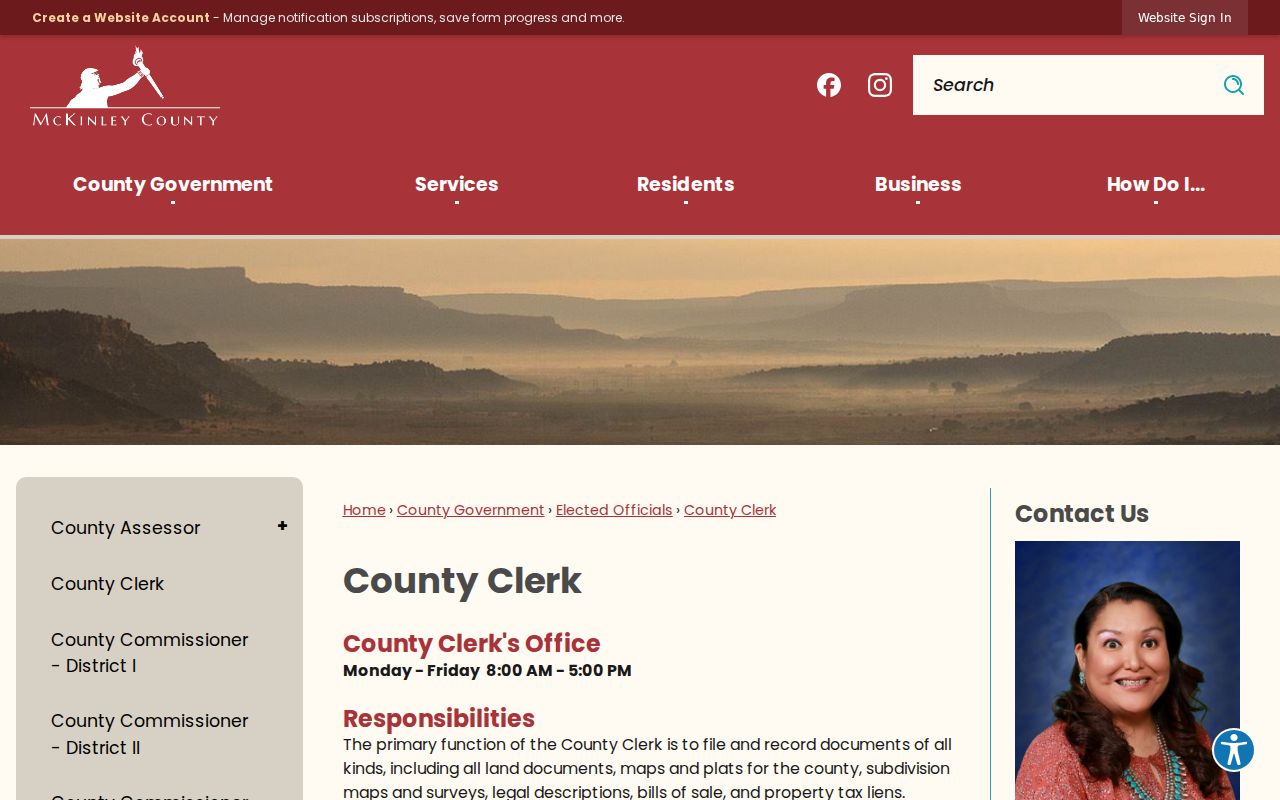
The image underscores the key limitation: a historic address trail may require an office inquiry because a public online grantor-grantee search was not verified.
Gallup Past Households in Context
Past residents are not always found in a deed. Relatives and other household members may appear only in dated directories or census material, while an ownership instrument can name only the party to the transfer. FamilySearch has located a catalog subject record for “Gallup (McKinley County, N. M.) city directory,” and its United States City and Business Directories collection is a useful search route. The available research did not verify a complete Gallup publisher, year, or shelf run. Treat the catalog as a lead and capture the actual image or item citation before relying on an entry.
The Octavia Fellin Public Library can help locate its catalog and local-history resources; the city page also identifies the Historic Rex Museum as available by appointment through the library. The New Mexico State Archives search gateway supports county, census, and genealogy research, with reference access on site and by phone, mail, and email. It is appropriate to ask either repository to confirm a title, year, format, or access condition.
- Choose one target year and find a directory or census record dated nearest to it.
- Record the repository, collection title, page or image, spelling, and address exactly as shown.
- Compare the next dated source rather than jumping across a long gap. Note whether the evidence names a householder, a business, or simply a building.
- Use the 1916 Sanborn sheet or a Clerk plat only to interpret the block or legal location.
- Return to the Gallup city-directory collections for collection-specific search routes, then document any unresolved gap.
Federal census images follow a 72-year release rule, and 1950 is the newest released census. Census evidence must be labeled by census date. It is historical context, not a present address.
Gallup Requests for Missing Files
When an address trail reaches a city permit, code, or council record not placed online, the City Clerk’s IPRA route offers several channels. Gallup accepts a written request in person, by mail, email, or fax, and its Inspection of Public Records procedure explains the request process. Include the address or parcel, record type, bounded date range, and preferred format. The city need not create a record that does not exist or assemble a new personal dossier.
The city’s form asks for the requester’s name, address, telephone number, a specific description, and whether copies are wanted. The city says ordinary copies up to 11 by 17 inches are $0.50 each and CDs or DVDs are $5; other costs vary. Under New Mexico IPRA, a custodian ordinarily explains delay within three business days and provides inspection or a written denial within 15 calendar days when the record is not immediately available. Ask to be notified before charges exceed a set amount.
Note: A narrow request tied to a parcel and date range is easier to route than a request for every record about an address.
Gallup Privacy Gaps in a Trail
There are legitimate reasons a trail of previous residents stops. A person may have used another name, had no taxable-account connection, lived on nontaxable land, or been protected by a records rule. New Mexico’s Safe at Home program provides substitute addresses and mail forwarding for eligible participants. Recent vital certificates, protected voter fields, and court records also have defined access limits. A missing entry is a gap, not a basis to search around a safeguard.
When an official field appears wrong, take the dated screenshot and record identifier to the custodian. The Assessor or GIS handles property-display questions, the County Clerk handles recorded instruments, and the City Clerk routes city records. Correcting an index entry and proving a legal conclusion are different tasks.